TB-500 research: what counts as repair?
New tissue, a closing wound and restored function are different results. The muscle paper makes that distinction impossible to ignore.
Regenerating fibers, unimproved strength
Broad TB-500 recovery claims look different to me after the dystrophin-deficient mouse experiment. After 6 months of full-length thymosin beta-4, regenerating skeletal-muscle fibers increased, yet muscle strength and systolic cardiac function did not significantly improve. Skeletal and cardiac fibrosis remained elevated.
The investigators successfully detected regeneration. The uncomfortable part is what regeneration did not deliver. I regard the functional result as more consequential than the attractive tissue finding, because the recovery reputation tends to imply that damaged tissue will work better.
These were mdx mice, a dystrophin-deficient model. The experiment used the parent protein. A routine athletic injury in a person, treated with the heptapeptide, would require a separate investigation. Both particulars limit the claim, but neither makes the missing strength gain disappear.

The rat wound result is about resurfacing
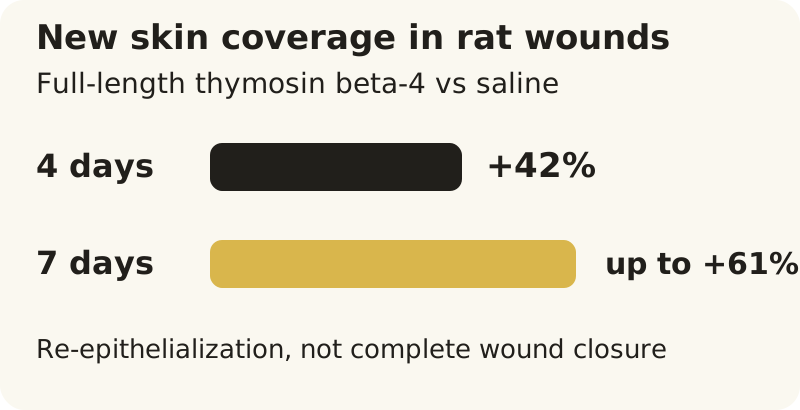
In the 1999 full-thickness rat-wound study, topical or intraperitoneal thymosin beta-4 increased re-epithelialization by 42% at 4 days and up to 61% at 7 days versus saline. Re-epithelialization means new surface skin covering the wound. Wound contraction increased by at least 11% by day 7, with more collagen deposition and angiogenesis, the growth of blood vessels.
The same paper reported that as little as 10 pg stimulated keratinocyte migration by 2–3-fold in cell assays. A skin cell moving in a dish and a rat wound resurfacing are separate observations, even when they sit in the same paper.
The breadth of measurements impresses me, especially the difference between migration and resurfacing. The trouble starts when “up to 61%” escapes its rat model and becomes a timetable for somebody's injury. The experiment did not establish a human healing time for TB-500.
The diabetic mouse paper gives the fragment a foothold
The diabetic and aged mouse wound paper studied thymosin beta-4 and a synthetic peptide containing its actin-binding domain. The smaller peptide reproduced aspects of wound repair. It gives the fragment argument something better than a resemblance in chemical names.
The scope is still dermal repair in mice. That paper earns the actin-binding region a foothold with me without turning it into a result for tendons, muscle strength, the heart or people. The broader parent-protein review discusses wound, hair-follicle and connective-tissue research; its scope is parent-protein biology across experimental settings.
The tendon and ligament argument remains thin: rigorous human evidence for unapproved musculoskeletal peptides remains scarce. A different injury is a different question.
Heart survival, stroke function, growing hair
The mouse cardiac experiment found that full-length thymosin beta-4 formed a functional complex with PINCH and integrin-linked kinase, activated Akt survival signaling, and improved early myocyte survival and cardiac function after coronary artery ligation. That is an animal finding about the parent protein, with a specified injury model.
The mouse experiment draws its force from the specified injury and the measured cardiac function. A verdict on every heart injury would give that mouse result more authority than its model permits. The functional measurement matters here for the same reason it mattered in the muscle paper: tissue activity has to deliver something the organ can do.
The rat embolic-stroke report found improved neurological function with thymosin beta-4. Its dose-response companion then showed that the largest tested amount did not bring significant benefit. The particulars of that experiment are on the study-amounts page.
Hair-growth interest likewise comes from full-length thymosin beta-4 in rats and mice, with follicle stem-cell migration and differentiation discussed in the parent-protein literature. These are distinct animal endpoints. None establishes that TB-500 grows human hair or repairs a human heart or brain.
Healthy volunteers and an eye-drop study
The intravenous Phase 1 study enrolled 40 healthy volunteers and tested full-length synthetic thymosin beta-4 at 42, 140, 420 and 1260 mg. It reported infrequent mild or moderate adverse events, no dose-limiting toxicities and no serious adverse events. Those amounts describe what that study administered; they are not recommendations. The participants' tolerance does not establish long-term fragment safety or injury-treatment efficacy.
The RGN-259 corneal-healing study examined ophthalmic thymosin beta-4. I value a human result more when its route and outcome remain attached. It cannot be expanded into proof about an injected heptapeptide.
The sports-medicine review describes the larger gap: rigorous human evidence remains scarce for unapproved musculoskeletal peptides. There are no completed controlled trials establishing the TB-500 fragment's human efficacy. The healthy-volunteer and corneal studies therefore remain valuable answers to narrower questions.
The newer work is getting more particular, too
The 2025 thymosin beta-4–exosome hydrogel study reported improved vascularized wound repair in a rodent biomaterial model. It investigated a particular delivery system. In rat cutaneous flaps, thymosin beta-4 improved survival and activated Wnt/β-catenin signaling. The experimental setting remains part of each result.
The 2024 work on pro-resolving pathways concerns full-length thymosin beta-4 in animal and in-vitro settings and the biology that helps an inflammatory response resolve. “Anti-inflammatory” compresses that into a much less interesting claim.
This increasingly particular direction is promising to me: a defined construct, delivery system or pathway, followed by a measured outcome. It leaves the tumor and blood-vessel concern in the conversation. The same process can have different consequences across tissues and situations.